Russia has now committed around three-quarters of the troops it had massed on Ukraine’s border.
Its air and artillery strikes have until now been limited.
Western officials say that Russia has still to destroy Ukraine’s air defences and gain supremacy in the air.
They also believe that Russia’s invasion is not going according to plan because it has met stronger resistance than expected and because of poor preparation. Armoured convoys have been running out of fuel.
But as Russia commits more of its resources and firepower to the fight, it could all change quickly.
Western officials on Monday said they’d seen a recent increase in Russian artillery strikes on cities including Kyiv and Kharkiv. They’ve expressed concern that indiscriminate firing into urban areas will lead to significant civilian casualties.
Human rights groups also say there’s evidence that Russia has been using cluster munitions, banned by many countries.
Russian setbacks could lead to more ruthless actions. Russia’s indiscriminate bombing campaign in Syria and, before that, Chechnya shows Russia under President Putin is more concerned about results than civilian casualties or international condemnation.
In five days of war, Russia has launched 56 rockets and 113 cruise missiles into Ukrainian territory, according to President Zelensky.
“We need to consider a complete closure of the sky for Russian missiles, planes and helicopters,” he has said, according to the Ukrainian National News Agency (Ukrinform).
In calling for a no-fly zone over Ukraine, he did not say who should enforce it, or how.
Monday’s peace talks were held against the backdrop of continued Russian bombardment of Ukrainian cities, he added.
He also condemned Russia’s role in the United Nations, saying that a country that commits war crimes should not be permitted to hold a permanent seat on the UN Security Council.
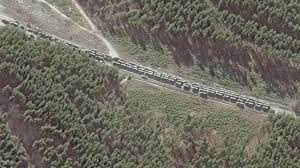
Newly released satellite imagery shows a massive convoy of Russian armour descending on Kyiv.
Pictures taken on Monday, before noon in Ukraine, show Russian military units near Antonov airport, about 27km (17 miles) from the centre of the capital.
According to Maxar Technologies, the satellite-imaging company that released the photos, the convoy is nearly 17 miles long (27km) and “contains hundreds of armoured vehicles, tanks, towed artillery and logistics support vehicles”.
To the west and north-west of Kyiv, satellite pictures show destroyed armoured vehicles and a damaged bridge near Irpin and Stoyanka.
Nina*, a resident in Berdyansk, described the scene when Russians descended into the port city in Ukraine’s southeast, on an arm of the Sea of Azov.
“The Russians entered our city four days after the war started. Within minutes, they were everywhere,” she said. Their armoured tanks were topped with troops and machine guns, and, to her dismay, they set up outside her house, Nina said.
“It was terrifying to spend the night on the floor in the bathroom in this day and age, with the lights out and barely breathing,” she said.
Nina said she saw claims on social media that the soldiers – young men in their 20s – were walking around the city asking for food because they were hungry.
“I felt pity for them. But then I thought that tomorrow they would go to the neighbouring city of Mariupol to kill our lads. I felt more pity for our lads,” she said.
In the morning, residents gathered outside government building in Berdyansk and sang the Ukrainian national anthem “face-to-face with Russian tanks”.
“Today, one of them was killed by Russian troops. Yesterday, one was killed and another wounded,” Nina said. They died because Russia thinks “we, Ukrainians, have no right to be independent”.
As we mentioned earlier, Western allies held a call to discuss Russia’s war on Ukraine.
On the call were leaders from Nato and G7 member states.
Downing Street says participants “agreed to pursue every avenue to ensure that Putin fails in his ambitions”.
According to the readout of the call, the leaders discussed the need for continued military support for the Ukrainian government and for an international response to the humanitarian situation on the ground.
No. 10 hailed the “The unity of message and action between countries in recent days”, including by removing certain Russian banks from the Swift messaging system.
The European Union has launched an unprecedented flurry of sanctions against Russia’s most powerful people and companies.
On Monday, it released a list of 26 individuals who will face sanctions.
Kremlin press secretary Dmitry Peskov
Alexander Ponomarenko, chairman of the board of Sheremetyevo International Airport in Moscow
Igor Sechin, CEO of the state-owned Rosneft Oil Company
Nikolay Tokarev, CEO of Transneft, the world’s largest oil pipeline company
Several Russian state TV presenters and journalists
The EU will also sanction the Gas Insurance Industry Company in Moscow, which reportedly aided the annexation of Crimea in 2014.
The full list is available here.
Dozens of people have been killed in Russian missile strikes on Ukraine’s second city, Kharkiv, officials say.
Videos shared on social media showed rockets landing in Kharkiv, in what some defence analysts described as typical of a cluster munition strike on a dense urban area.
Russia has previously denied targeting residential areas.
Thick black smoke could also been seen billowing from destroyed a shopping centre in the city of Chernihiv, in the north of Ukraine.
The footage in this video has been verified by the BBC, but the sources of some sections are unknown.
he US has expelled 12 Russian diplomats at the United Nations over national security concerns, US and Russian diplomats have said.
The members of Russia’s mission have been asked to leave the US for engaging in non-diplomatic activities.
“Those diplomats that have been asked to leave the United States were engaged in activities that were not in accordance with their responsibilities and obligations as diplomats,” Deputy US Ambassador Richard Mills told the UN Security Council, without elaborating further.
Russia’s UN Ambassador Vassily Nebenzia told reporters they had been asked to leave by 7 March, Reuters news agency reports.
On Slovakia’s Vyske Nemecke border, large canvas tents stood where previously there was just a muddy field.
Inside, families sheltered from the wind that came in icy bursts. A diesel generator chugged away. People milled about, some with a purpose, others aimlessly.
“Kharkiv doesn’t want war. We don’t hate Russian people. We hate war,” said Nasta, who’d fled the bombing of Kharkiv with her three children, aged eight, six and two.
Nasta was worried for her sister and parents, left stranded in the bombardment. Her father is diabetic.
Other tents were bursting at the seams with packets of nappies and wet wipes, clothes, bottled water. Soup, tea and coffee was ladled from tureens, sandwiches were made, people handed out SIM cards. All have been provided by a combination of charities and local people. The response to the crisis from Slovaks has been overwhelming.
But not everyone here had Europe’s large Ukrainian diaspora to turn to.
“I was studying, staying up through the night doing an assignment, when all of a sudden there were bomb blasts,” said Love, a Nigerian student at Kharkiv’s National Aerospace University.
“I don’t want to go home to Nigeria,” Love said. Luckily, she was traveling with her sisters, and her parents had sent her some money.
“Let’s just see what happens.”
The US Defence Department says that almost 75% of the Russian forces assembled on Ukraine’s borders are now inside the country.
The main advance of troops is now positioned about 25 km from the capital Kyiv, roughly a 5 km gain since Sunday.
Soldiers have yet to capture two key cities: Kharkiv in the northeast and Mariupol in the South.
As Western officials have previously noted, troops are not making the progress they had planned due to logistical issues and fierce resistance by Ukrainian fighters.
“They’re using pretty much everything that they have in their arsenal, from small arms all the way up to surface to air missiles to try to slow down the Russians,” a senior US defence official said.
The official said the US has not seen any indications yet of specific Russian movements with regard to President Putin’s nuclear deterrence announcement on Sunday.
The Pentagon is also yet to see Belarusian forces moving to provide backup to the Russians.
Ukraine’s Ministry of Internal Affairs has said that Russian missile strikes have hit residential buildings in the Kyiv region.
Three five-storey buildings were destroyed by a rocket attack about three hours ago, according to the ministry’s Facebook page.
A spokeswoman for the region’s State Emergency Service said it was searching for at least two people buried under the rubble in the town of Bila Tserkva. The BBC has not been able to independently verify the claims.
Germany is sending Tornado warplanes and a maritime patrol aircraft on a reconnaissance mission to the Baltic Sea area, Germany’s mission to Nato has said.
A spokesperson for the defence ministry in Berlin said she could not immediately give any details due to operational security concerns, Reuters news agency reports.
Earlier in the day, the German navy dispatched six additional warships, four of them to the Baltic Sea.
Night has fallen across Ukraine after the fifth day of Russia’s invasion.
If you’re just joining us, or catching up on the latest developments, here’s what’s been going on:
Air raid sirens have been heard again in Kyiv and residents have taken shelter in the wake of fresh reports of new Russian attacks on the outskirts of the Ukraine capital
Dozens of civilians were killed earlier today in Russian missile strikes on Ukraine’s second city, Kharkiv, the interior ministry said
Negotiators from Kyiv and Moscow have held talks in Belarus in a bid to end the conflict. Russia says both sides agreed to continue discussions and will meet again “in the next few days”
Ahead of that meeting, Ukraine’s President Zelensky urged Russian troops to lay down their weapons and called for immediate EU membership for his country
Shell has announced an end all of its joint ventures with the Russian energy company Gazprom following the invasion of Ukraine
Global economic sanctions saw Russia more than double its interest rate to 20% in a bid to halt a steep fall in the value of the rouble
The UN says more than half a million refugees have now fled Ukraine for neighbouring countries
Fifa and Uefa have suspended all Russian clubs and national teams from competitions
Underground and above ground in central Kyiv, more and more life has been slowing to a stop.
Independence Square – Maidan, in Ukrainian – is the city’s heart, and is typically bustling. Today, it’s been deserted.
The underground metro now only operates a train every hour or two and carriages are half empty. Meanwhile, people continue to use the stations, deep beneath the city, as bomb shelters.
Some of the people out on the streets today were Russian-speakers, the people Russia has accused Ukraine of persecuting.
A young man approached me with a black AK-47 on his shoulder and a yellow band around his right arm – a symbol that he is a civilian volunteer. He was called Artem and uses Russian and Ukrainian mixed in his conversation.
Artem said that as a Russian-speaker, he’d never encountered any problems in Ukraine before the invasion.
“This war has united people as never before,” he said.
telling people not to take radiation-blocking iodine pills without advice from authorities.
Many countries, including the UK, have a stockpile of these tablets in case of a major nuclear accident or leak. They should only be used if recommended by medical experts though for good reason.
There are health risks associated with taking them, so they are not something people should try to buy or acquire themselves to take.
Potassium iodide pills help block radioactive iodine from being absorbed in a part of the body called the thyroid gland, which is located in the neck.
They are a useful counter-measure because radioactive iodine that is breathed in or consumed in food and drink can be stored the gland for some time. The tablets only help protect the thyroid gland, not other parts of the body.
On Sunday, President Putin ordered his military to move Russia’s “deterrent forces” – which include nuclear weapons – to a “special mode of combat duty”. But what exactly does that mean?
It is not entirely clear, Western analysts say. UK officials say the language Putin used did not quite fit with their understanding of the alert levels for Russian nuclear weapons.
Some think Putin was ordering a move from the lowest alert level, “constant”, to the next level up, “elevated”, (with “military danger” and “full” still above) but that was not certain. Each move increases readiness for weapons to be used.
Many, though, have interpreted the move primarily as a form of public signalling, rather than indicating a real intent to use such weapons, which Putin knows will bring nuclear retaliation by the West. UK Defence Secretary Ben Wallace has indicated he believes the announcement was primarily “rhetoric”.
Google has disabled live traffic data in Ukraine from being displayed on its Maps app in the wake of the Russian invasion.
The app displays how busy roads are by collecting anonymous data from Android smartphones, but it has now been switched off in the region temporarily to protect users.
Google confirmed the move to the BBC, having told Reuters it took the action for the safety of local communities, after consulting regional authorities.
While traffic data has been disabled, normal maps navigation features are still functioning properly in the area.
Find out more about Google’s move here.
A number of old videos and photos are being passed around, described as current when in reality they’re old – and in some cases from other countries around the world.
And a different type of claim is being made around pictures that were on the front pages of news sites around the world over the weekend.
Some people – running a variety of pro-Russia and conspiracy-themed accounts – claim the photo above, of a woman injured in a Russian attack, is really from a 2018 gas explosion. That’s not true.
The photo was taken on 24 February and has been verified by the photographers who took them and the metadata attached to the images
Fears that Russia would launch a so-called “cyber war” to accompany its invasion have so far been unfounded.
But there is chaos in the cyber realm. Ukraine is under a constant bombardment of small-scale cyber attacks from unknown sources.
We don’t know where these attacks are coming from but Western intelligence services have blamed a recent wave of low-level DDoS (Distributed Denial of Service) hacking on Russian military intelligence hackers.
The Ukrainian authorities also blame Belarusian state hackers for attempted phishing and malware hacks.
We also know that vigilante Russian hackers are operating too, perhaps independently of the authorities.
But the activity that is gaining the most attention and potentially causing the most problems is actually against Russia.
“Hacktivist” group Anonymous claims it defaced Russian news websites with Ukrainian messages of support, and say they even interrupted a Russian TV channel.
But these fleeting low-level attacks are hard to verify and some hackers claiming to be Anonymous are notorious attention-grabbers.
Meanwhile a Ukrainian governement channel on the messaging platform Telegram has emerged calling itself the “IT Army of Ukraine”, gathering 230,000 members and the Ukrainian authorities are publishing details of which Russian targets to hack.
The amount of hacking taking place against Russia is extraordinary but at the moment it can be seen as cyber vandalism causing chaos and confusion more than serious cyber conflict.