A tech company, Signal Alliance Technology Holding, has called for increased investment in data centres to build a resileint capacity, adding that the current capacity in the country is just about 20 per cent of what South Africa has.
Its Chairman, Collins Onuegbu, spoke against the backdrop of the Central Bank of Nigeria (CBN’s) directive to financial institutions to localise payment-related data by January next year.
He commended the directive of the CBN because it will guarantee data sovereignty which has become what he described as the “new real estate”.
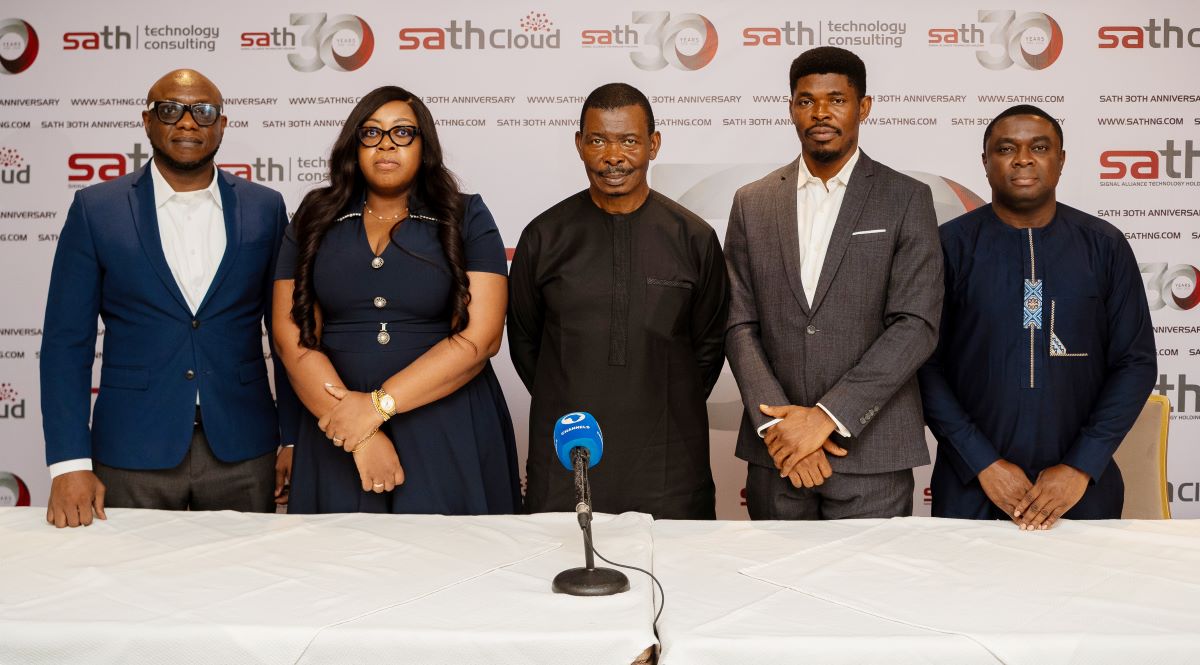
Onuegbu who fielded questions from reporters during a forum to mark the 30th anniversary of the company in Lagos yesterday Lagos under the theme “Built for This. Ready for What’s Next” said the country required both data centre finance and capacity to maximize the full benefit of localizing data.
He said: “So from a business point of view, I think that we should encourage local development; in a way, I like what CBN is doing.
“There’s something called data sovereignty where you have to own your data because it’s new real estate. And I think that we should have policies that allow us to keep at least critical data locally. Not everything.
“We’ve had customers before who say, we want to keep everything on premises. But you forget that if you send an email today, any email today you send, I think America sees 100 per cent of it, China sees 95per cent of it. So businesses go around the world and come back.
“I don’t think that is going to change. So what I mean is that there’s something that you don’t want to pass through that system. You make sure that you own your mail since I’m going there.
“That side stays locally or something. I think it’s important for us. I talked before about the data centre capacity in Africa. Any policy we can make to encourage more data centres to be in Africa is very good. I think it’s important. It doesn’t mean that even Microsoft doesn’t break up data centres,” he said, adding that what’s happening now is AI which he said is about data centres.
“It shows you how far behind we are. So if you want to be an entrepreneur, the challenge is there for you. Solve that problem.
“Solve that problem. It’s good to shout AI, AI, AI, but AI today is driven by capacity for data centres. You can see what is happening.
“I’m sure you see what is happening globally. We have to solve some of the constraints that make it difficult for us to be front-end players in technology. So if you’re aspiring today, I think you have to identify these problems and solve them.
“And some people are solving them. There are a lot of tech companies that are trying to solve the power problem. If they can’t solve the power problem, they can’t solve the data centre problem,” Onuegbu said.
Also speaking to the matter on the occasion, Managing Director of SATH Cloud, Busola Komolafe, Managing Director of SATH Technology Consulting, Kenneth Ufomba, said the company has already opened talks with the financial institutions, especially fintech, to help them localize their data.
She said: “We are in partnership with a lot of banks, even other processors, other fintechs, you know, that are already born in the cloud. So what we have been doing, for most of the banks, most of their data is not really on the cloud.
“Most of their transactions are not on the cloud. But people that are born in the cloud, they have their data in the cloud. So what we have been doing is that we have been engaging the banks, we have been doing a lot of assessments, we already have partnership with two different OEMs or providers.
“We are already presenting options to them because we need to actually move those data to be stored within Nigeria, look after it within Nigeria. So for us, we have a questionnaire that we have developed for the banks already.
“Even for the banks, we already have several committees looking into this within the system. Assessing what’s already ongoing, what do we have online, what is on-premise, what’s in the cloud. But we have some customers as well that are born in the cloud.”
According to her, some of the banks have their stuff with another OEM that have things stored in the cloud “because we are in partnership with Microsoft, we are in partnership with AWS, we are in partnership with other local partners as well that actually handle local storage as well, which I won’t mention their names on this. So right now, after the assessment, we are supporting them in the migration because we have competence around migration, which is the core of what we do.
“We are trying to help businesses migrate their information to the cloud. But right now, we’re going to bring it back to on-premise local storage. So we’re going to work through with them on this.
People born in the cloud, they have a view of what they already stored in their system in the cloud. We are already assessing, looking at how long it’s going to take, what data we are moving. “We’re already planning a session with the fintechs, and also with the banks. It’s called an independent business session. I’m speaking on this policy as well, which is going to happen next month. So that will be everywhere. It is going to be for different segments. This year, one bank will be in attendance, the fintechs, the different providers as well will be in that meeting,” she added.
Ufomba said SAS Technology Consulting already has a partnership with Huawei just for completeness. Huawei has local data centres in Nigeria. So it’s easier. “But again, like she said, most of the top tier banks have complied with this over the years. I mean, even though they are mostly in Microsoft, Azure or AWS, they’ve complied just keeping that particular data that the regulator says can’t stay outside Nigeria, localising it. So they don’t have a problem.
“The people that this impacts most are those fintechs, those companies who are born in the cloud who are very agile in their strategy, who don’t have the liberty of housing a fourth tier data centre, who are starting to want to move fast. So those kinds of organisations we are talking to them, we’re going to have sessions with them, already having some of them who are talking to, to say, hey, since you’re born in the cloud, do you want to look around the options we have in Nigeria? Or how can we help them structure the organisation? First, do an assessment that can help them say, okay, this data is impacted, this is not impacted, and guide them. So we’re a consulting company,” he said.
As part of the anniversary celebrations, the Group also announced the rebranding of two of its subsidiaries. CloudSA will now operate as SATH Cloud, while Signal Alliance Consulting will become SATH Technology Consulting.
The rebranding reflects the Group’s continued evolution and its commitment to creating a more unified brand architecture that supports growth, innovation, and deeper value creation for clients.
In his remarks, Onuegbu, described the anniversary as a significant milestone in the company’s history.
“Thirty years ago, we set out with a simple but ambitious goal: to help organisations unlock the power of technology. Today, we celebrate not just longevity, but the impact we have made, the relationships we have built, and the opportunities that lie ahead.”
He noted that the company’s growth has been driven by a commitment to innovation, strategic partnerships, technical excellence, and a relentless focus on customer success.
“Our story has always been one of transformation. We have continuously reinvented ourselves to meet the changing needs of the market, and today’s announcement represents another important step in that journey.”
The newly unveiled SATH Cloud will continue to provide cloud infrastructure, managed services, and digital transformation solutions that help organisations become more agile, secure, and efficient.
Similarly, SATH Technology Consulting will continue to support organisations through strategic advisory, business transformation, enterprise architecture, technology strategy, and digital innovation services.
According to the Group, the rebranding is designed to strengthen alignment across its businesses while reinforcing a shared vision for the future.
Komolafe said the new identity reflects both continuity and ambition. “While our name is changing, our commitment to helping clients leverage cloud technologies to accelerate growth and transformation remains stronger than ever. SATH Cloud reflects who we are today and where we are headed tomorrow.”
Ufomba described the rebranding as an important milestone in the firm’s evolution. “The transition to SATH Technology Consulting better reflects our role as a strategic partner helping organisations navigate complex business and technology challenges. It reinforces our commitment to delivering insight-led solutions that create measurable value,” he said.
Looking ahead, the company reaffirmed its commitment to driving innovation and supporting Africa’s digital transformation agenda through investments in emerging technologies, talent development, strategic partnerships, and customer-centric solutions.
As it enters its fourth decade, the Group says it remains focused on helping organisations adapt, compete, and thrive.