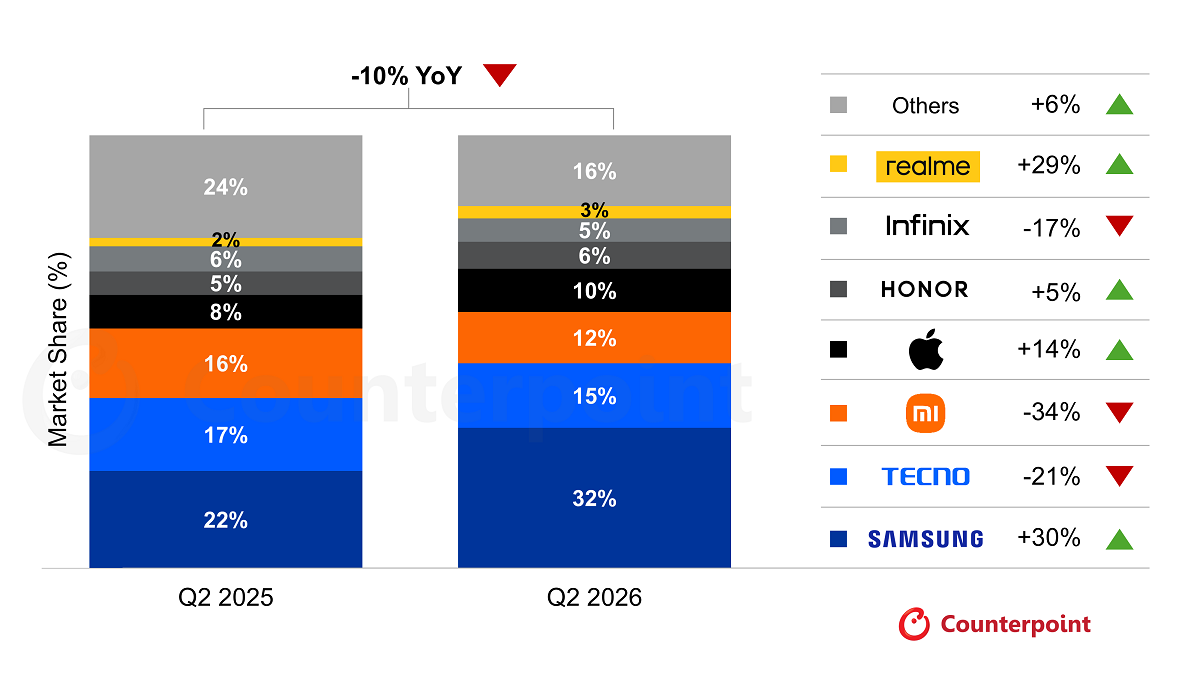
The smartphone market of Middle East and Africa (MEA) declined in second quarter (Q2) 2026, but Samsung, realme, and Apple rose significantly. With no new demand, brands like Samsung gained from their competitor’s volume.
According to Counterpoint Research, the comeback of declining brands will be more difficult than just an expansion, particularly against a market leader like Samsung where consumers are usually locked into the ecosystem.
The premiumization is not only driven by consumer demand, but component scarcity which is pushing the market up the price curve. The sub-$250 segment fell 26per cent while 5G shipments grew eight per cent. A market built on entry-level volume does not easily preimmunize to higher segments driven by consumer desire.
Regional growth is becoming an allocation decision. realme expanded in MEA by diverting units from India rather than by securing additional supply, turning geography into a lever in a constrained market.
5G shipments to the MEA region grew eight per cent YoY in Q2 2026, while global 5G shipments rose only one per cent YoY. The divergence reflects both a low regional base in Q2 2025 and the rapid buildout of 5G networks and supporting policy across the region. Apple and Samsung together were the primary drivers of the region’s 5G growth.
The region’s overall smartphone market performance was weighed down by the sub-$250 segment, which fell 26per cent YoY, the steepest decline of any band, as the ongoing memory crisis pushed original equipment manufacturers (OEMs) to ration constrained supply toward higher-margin models. Counterpoint Research Analyst Ahmad Shehab said: “Q2 2026 already projected to be the weakest quarter of the year, largely because of the memory crisis, as well as the shift in the Islamic calendar against the Gregorian calendar which concentrated all H1 occasions into Q1.
“The memory crisis hit the market hard, though unevenly. Transsion and Xiaomi were hit hardest, steeply impacting their market shares, because their volume is concentrated in exactly the entry-tier segment, which is the most exposed to the memory price crunch.”
That displacement created an opening. Samsung captured much of the underserved demand, expanding notably at the expense of other OEMs. The brand’s A07 and A17 models performed well, alongside the recently launched S26 flagship lineup. Similarly, the MEA market was an expansion opportunity for realme during the quarter, despite its global smartphone shipments falling 23per cent YoY during the period under review.
The brand aimed to serve the untapped demand in the MEA market by allocating significantly more units here, at the expense of other markets like India and China. This highlights realme’s strategic view of the budget-focused MEA market, where it aims to expand and maintain a larger share.
MEA is a market built on entry-level volume and is being pushed up by the price curve. This is not due to rising consumer demand, but by component scarcity, making the eight per cent 5G figure partly a symptom of that squeeze rather than a separate story.