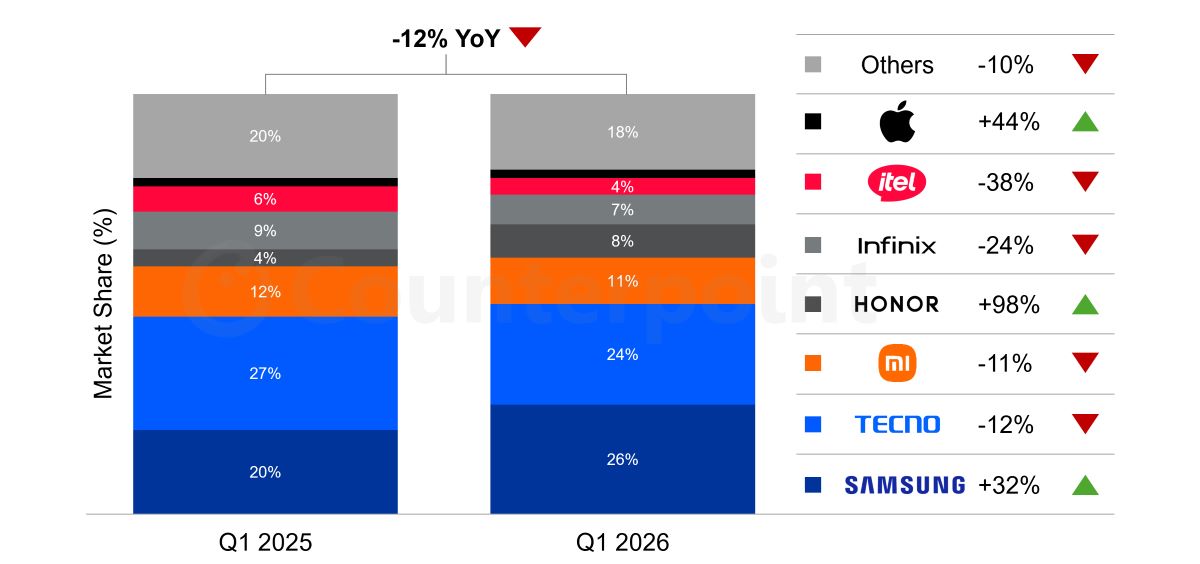
Smartphones shipments to Nigeria and other parts of Africa declined 12 per cent year-on-year (YoY) in the first quarter (Q1) of this year, according to Counterpoint Research’s Market Monitor Service.
Although the region sees a high number of events in the period under review, such as the reopening of schools, Valentine’s Day, Mother’s Day, and Ramadan, the memory crisis weighed more heavily on the market, driving steep declines and, importantly, a reshuffle in the top five rankings.
Commenting on the market dynamics, Research Analyst Ahmad Shehab said: “Despite rising fuel prices, the conflict in the Middle East had a more limited impact on Africa in Q1, with no major economic issues arising like salary cuts or employee layoffs. However, the price increases driven by rising memory costs were enough to dampen market performance and reshuffle the rankings among the top five brands.
“While the price increases may appear manageable in some markets, Africa remains one of the most price-sensitive smartphone markets globally. With average monthly incomes as low as $177 and $193 in countries such as Malawi and Rwanda, respectively (according to ILO) International Labour Organisation, even modest price increases can become significant barriers to purchase, particularly with a layer of taxes and levies added on top.”
Furthermore, inventory shortages not only affected pricing but also reshaped Africa’s top five smartphone rankings. Stocking decisions made months earlier ultimately translated into measurable share gains or losses for these brands. Samsung and HONOR were best positioned to capitalize on the shortage, leveraging their strong inventories to expand market share at the expense of TECNO and Infinix, respectively.
From the air interface perspective, 5G smartphone adoption accelerated in Africa even as the overall market contracted. This growth in 5G adoption was supported by the continuous expansion of coverage and infrastructure across the region.
For example, 5G coverage in South Africa reached 58 per cent in 2026, according to ICASA, and 48per cent in Botswana, according to BOCRA. Along with that, the trickle-down of 5G into the upper entry tier and mid-tier has boosted adoption growth. Penetration in terms of shipment volumes climbed 19per cent YoY during the period under review, mainly driven by Samsung and HONOR, and largely concentrated in South and North African countries like Morocco, Tunisia, Egypt and South Africa. These countries have also introduced policies to support 5G expansion.
HONOR recorded robust growth of 98 per cent YoY in Africa, overtaking Infinix. HONOR deployed an affordable-premium positioning in Africa, utilizing its Middle East playbook and differentiating itself from other Chinese OEMs that compete primarily in the ultra-entry tier. However, the strategy currently focuses on selected markets such as South Africa, Egypt and Nigeria. HONOR is strengthening its presence in these countries through carrier partnerships and sponsorship of popular events.
Samsung overtook TECNO to become the market leader. This came as a result of Samsung’s strong inventories, filling in the gap left by TECNO and other Chinese brands struggling with shortages, such as itel and realme.